
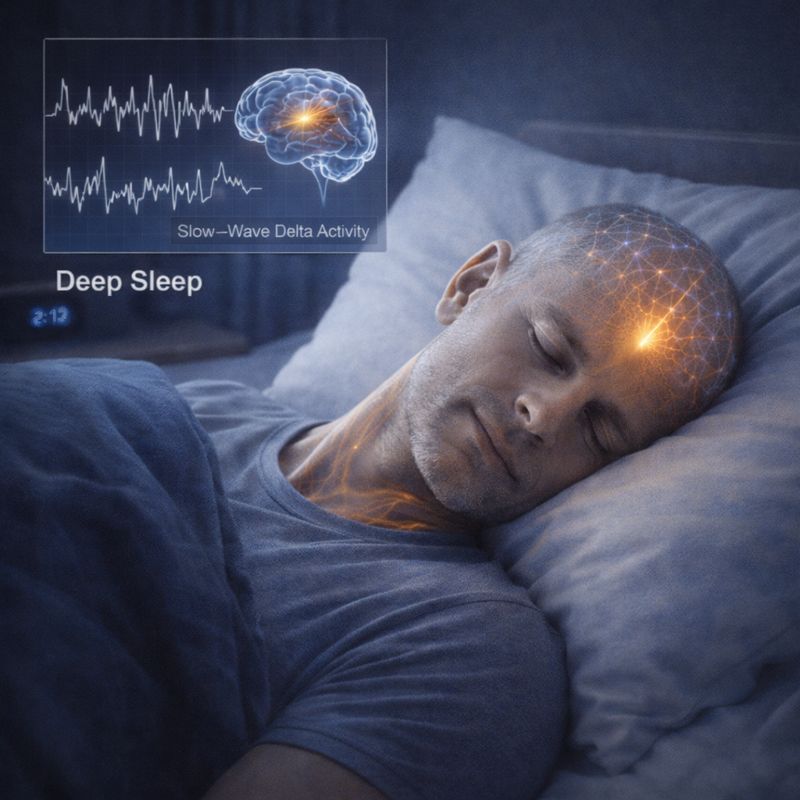
Deep sleep is the most physically restorative stage of sleep. While all sleep stages play a role in recovery, deep sleep is where the body repairs tissue, strengthens the immune system, consolidates physical recovery, and resets the nervous system.
Many sleep problems are not caused by sleeping too little, but by getting too little deep sleep. This article explains what deep sleep is, how it works, why it matters, and what happens when it is consistently reduced.
What Is Deep Sleep?
Deep sleep, also known as slow-wave sleep, is a stage of non-REM sleep characterized by slow brain waves, reduced muscle activity, and minimal responsiveness to external stimuli.
During deep sleep:
- Brain activity slows significantly
- Heart rate and breathing decrease
- Muscles fully relax
- The body enters its primary repair mode
This stage typically occurs in longer blocks during the first half of the night.
Where Deep Sleep Fits in the Sleep Cycle
Sleep occurs in cycles lasting roughly 90 minutes, moving through light sleep, deep sleep, and REM sleep.
Deep sleep is most prominent early in the night and gradually decreases as morning approaches. Circadian rhythm strongly influences when deep sleep occurs and how stable it is.
Disrupted sleep timing or poor circadian alignment reduces the amount and quality of deep sleep.
Why Deep Sleep Is Critical for Physical Recovery
Deep sleep is when the body performs its most intensive repair processes.
Key recovery functions during deep sleep include:
- Tissue repair and muscle recovery
- Release of growth hormone
- Cellular regeneration
- Immune system strengthening
Athletes and physically active individuals are especially dependent on sufficient deep sleep for recovery and performance.
Deep Sleep and the Nervous System
Deep sleep allows the nervous system to shift into a parasympathetic state, reducing stress load and restoring balance.
This process:
- Lowers baseline stress levels
- Improves stress resilience
- Supports emotional regulation
- Reduces nervous system fatigue
Insufficient deep sleep leaves the nervous system in a chronically activated state.
Deep Sleep and Brain Health
Although REM sleep is often associated with memory, deep sleep plays a critical role in brain maintenance.
During deep sleep:
- Metabolic waste is cleared from the brain
- Neural connections are stabilized
- Cognitive recovery occurs
Reduced deep sleep has been linked to impaired cognitive performance and mental fatigue.
How Much Deep Sleep Do You Need?
Deep sleep needs vary by individual, but most adults require roughly:
- 15–25% of total sleep time
- About 1–2 hours per night
Deep sleep naturally declines with age, but lifestyle and circadian alignment strongly influence how much is achieved.
Signs You’re Not Getting Enough Deep Sleep
Common indicators of insufficient deep sleep include:
- Waking up unrefreshed
- Persistent physical fatigue
- Poor workout recovery
- Increased soreness
- Low stress tolerance
- Brain fog
These symptoms can occur even when total sleep duration appears adequate.
What Reduces Deep Sleep?
Several modern habits significantly reduce deep sleep:
- Irregular sleep schedules
- Late bedtimes
- Alcohol consumption at night
- Late meals
- High evening stress
- Late stimulant use
- Poor circadian alignment
Deep sleep is highly sensitive to timing and nervous system state.
Circadian Rhythm and Deep Sleep
Circadian rhythm determines when deep sleep occurs and how efficiently it is produced.
When circadian rhythm is aligned:
- Deep sleep occurs earlier and more consistently
- Sleep cycles stabilize
- Recovery improves
Circadian disruption shifts or fragments deep sleep, reducing its restorative value.
Deep Sleep vs Sleep Duration
More time in bed does not guarantee more deep sleep.
Poor sleep quality can result in:
- Long sleep duration
- Low deep sleep percentage
- Poor recovery
Optimizing deep sleep often has a greater impact than simply increasing total sleep hours.
Can You Increase Deep Sleep?
Deep sleep cannot be forced, but it can be supported by creating the right conditions.
Foundational factors include:
- Consistent sleep timing
- Strong circadian alignment
- Low evening stress
- Reduced nighttime stimulation
Deep sleep improves naturally when the body feels safe, relaxed, and well-timed.
Deep Sleep and Long-Term Health
Chronic reduction in deep sleep has been associated with:
- Impaired immune function
- Increased injury risk
- Reduced metabolic health
- Accelerated aging processes
Deep sleep is not optional recovery — it is a biological necessity.
Final Thoughts: What Is Deep Sleep and Why It Matters
Deep sleep is the cornerstone of physical recovery, nervous system reset, and long-term health. Many sleep problems stem not from insufficient sleep time, but from insufficient deep sleep caused by circadian disruption and lifestyle factors.
Protecting deep sleep through proper timing, alignment, and recovery habits is one of the highest-impact strategies for improving sleep quality and overall performance.
Continue Exploring Deep Sleep & Recovery
This article is part of the Deep Sleep & Recovery section within the Sleep Optimization framework.
Return to the main guide:
/sleep-optimization/deep-sleep-recovery/