
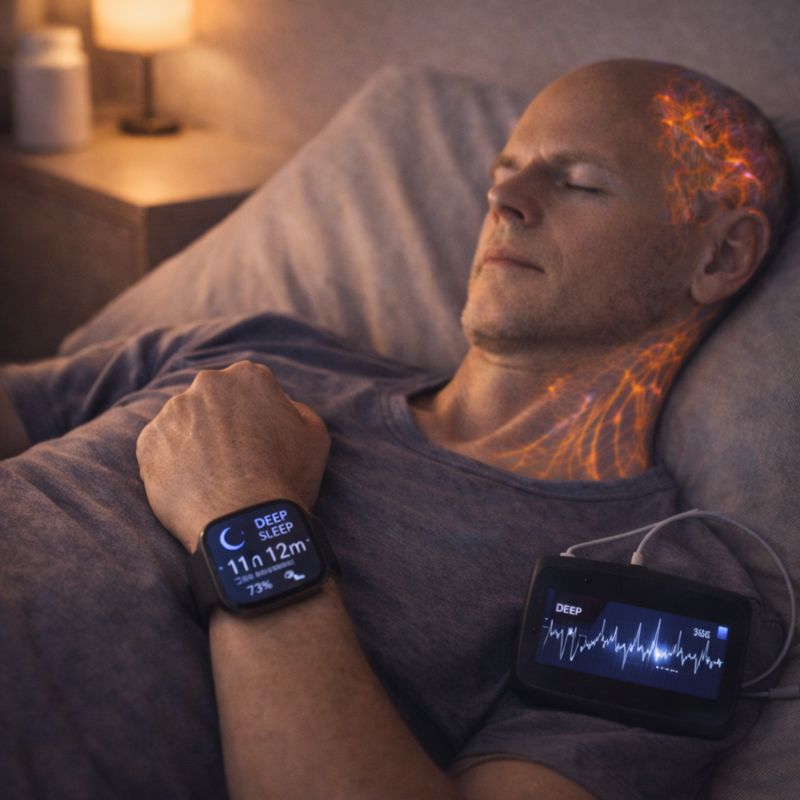
Deep sleep is one of the most important components of sleep quality, yet it is also the hardest to measure accurately. With the rise of wearables and sleep tracking apps, many people rely on nightly deep sleep numbers without understanding what those numbers actually represent — or how reliable they are.
This article explains how deep sleep is measured, the limitations of common tracking methods, and how to interpret deep sleep data accurately without becoming misled by the numbers.
What Deep Sleep Really Is
Deep sleep, also known as slow-wave sleep, is defined by specific brainwave patterns measured through electroencephalography. It is characterized by slow delta waves, reduced responsiveness to external stimuli, and strong physical recovery processes.
True deep sleep can only be directly identified by measuring brain activity.
The Gold Standard: Polysomnography
The most accurate way to measure deep sleep is polysomnography, a clinical sleep study.
Polysomnography measures:
- Brain activity
- Eye movement
- Muscle tone
- Heart rhythm
- Breathing patterns
This method directly detects slow-wave brain activity and is considered the gold standard for sleep staging.
However, it is expensive, inconvenient, and not practical for nightly use.
How Wearables Estimate Deep Sleep
Most consumer sleep trackers do not measure brainwaves.
Instead, they estimate deep sleep using indirect signals such as:
- Movement
- Heart rate
- Heart rate variability
- Breathing patterns
- Skin temperature
Algorithms combine these signals to infer sleep stages, including deep sleep.
Why Wearables Can’t Measure Deep Sleep Directly
Because wearables are worn on the wrist or finger, they cannot detect brain activity.
As a result:
- Deep sleep is inferred, not measured
- Accuracy varies between devices
- Exact deep sleep minutes are estimates
This does not make wearables useless, but it does limit precision.
Accuracy of Popular Sleep Trackers
Most modern wearables are reasonably accurate at detecting sleep versus wakefulness.
They are less accurate at distinguishing:
- Light sleep vs deep sleep
- Deep sleep vs REM sleep
Accuracy improves when analyzing trends over time rather than single nights.
Why Night-to-Night Deep Sleep Numbers Fluctuate
Deep sleep naturally varies from night to night.
Fluctuations occur due to:
- Stress levels
- Exercise load
- Sleep timing
- Alcohol or food intake
- Circadian alignment
Small variations are normal and do not necessarily indicate a problem.
Why One Night of Data Means Very Little
Single-night deep sleep readings are often misleading.
Deep sleep should be evaluated:
- Over multiple weeks
- As an average
- In relation to how you feel
Short-term dips or spikes rarely reflect true recovery changes.
Using Trends Instead of Absolute Numbers
The most accurate way to use sleep tracking data is through trend analysis.
Useful patterns include:
- Gradual increases or decreases over weeks
- Changes after lifestyle adjustments
- Consistent correlations with fatigue or recovery
Trends are far more meaningful than exact minute counts.
Functional Signs vs Device Data
Deep sleep quality is ultimately reflected in how you function.
Signs of adequate deep sleep include:
- Feeling physically restored
- Good workout recovery
- Stable energy levels
- Low baseline soreness
If these signs are present, deep sleep is likely sufficient even if tracker numbers vary.
When Wearable Data Is Most Useful
Sleep trackers are most helpful for identifying:
- Effects of alcohol
- Effects of late meals
- Effects of exercise timing
- Effects of stress
- Changes in sleep schedules
They are tools for comparison, not diagnosis.
When Sleep Trackers Become a Problem
Obsessing over sleep data can worsen sleep quality.
This phenomenon, sometimes called sleep anxiety, occurs when:
- You chase perfect numbers
- You worry about nightly fluctuations
- You let data override how you feel
Stress itself reduces deep sleep, making fixation counterproductive.
Why Deep Sleep Percentage Matters More Than Minutes
Total deep sleep minutes depend on total sleep duration.
Deep sleep percentage provides better context by showing how much of your sleep is restorative relative to total sleep time.
Most adults fall within a healthy range of roughly 15–25 percent.
How Circadian Rhythm Affects Measured Deep Sleep
Deep sleep occurs predominantly in the first half of the night.
Late bedtimes or circadian misalignment:
- Shift deep sleep later
- Reduce total deep sleep
- Increase fragmentation
Tracking deep sleep alongside sleep timing provides better insight.
How Lifestyle Changes Reflect in Deep Sleep Data
Accurate measurement involves linking changes to outcomes.
Lifestyle adjustments that often improve deep sleep trends include:
- Earlier, consistent bedtimes
- Reduced alcohol intake
- Better stress management
- Improved evening routines
Changes should be evaluated over weeks, not nights.
When to Question Your Deep Sleep Data
Deep sleep data should be questioned if:
- It contradicts how you feel consistently
- It changes dramatically without lifestyle changes
- It creates anxiety or stress
No consumer device can replace subjective recovery signals.
How to Measure Deep Sleep Accurately in Practice
The most accurate practical approach combines:
- Wearable trend data
- Consistent sleep timing
- Subjective recovery assessment
- Performance and energy feedback
Deep sleep accuracy improves when data is contextualized rather than isolated.
Final Thoughts: How to Measure Deep Sleep Accurately
True deep sleep can only be measured by brainwave analysis, but wearable devices still provide useful directional insight when used correctly. Accuracy comes from observing trends, not chasing precise numbers.
The goal of measuring deep sleep is not perfection — it is understanding how lifestyle, stress, and timing affect recovery. When measurement supports awareness rather than anxiety, it becomes a powerful tool for improving sleep quality.
Continue Exploring Deep Sleep & Recovery
This article is part of the Deep Sleep & Recovery section within the Sleep Optimization framework.
Return to the main guide:
/sleep-optimization/deep-sleep-recovery/