
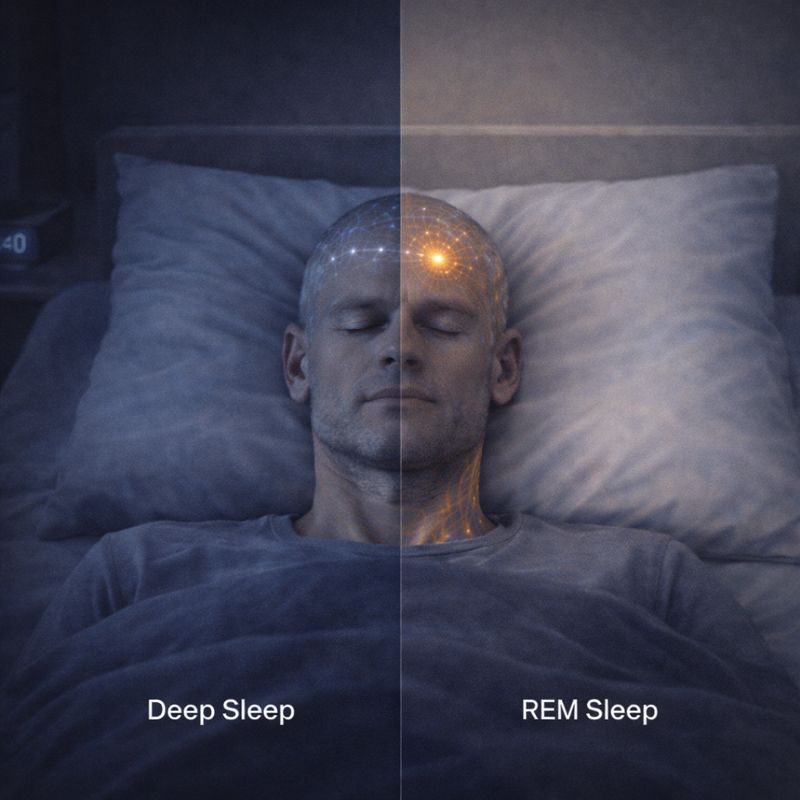
Deep sleep and REM sleep are the two most important restorative stages of sleep, but they serve very different biological purposes. Many people focus on total sleep time without understanding how these stages work — or why lacking one cannot be compensated by more of the other.
This article explains the key differences between deep sleep and REM sleep, what each stage does for the body and brain, and why balanced sleep architecture is essential for recovery, performance, and long-term health.
What Is Deep Sleep?
Deep sleep, also known as slow-wave sleep, is a stage of non-REM sleep characterized by slow brain waves, low heart rate, and minimal responsiveness to external stimuli.
Deep sleep is primarily responsible for physical restoration. During this stage, the body enters its most anabolic and recovery-focused state.
What Is REM Sleep?
REM sleep, which stands for rapid eye movement sleep, is a unique sleep stage marked by high brain activity, vivid dreaming, and temporary muscle paralysis.
REM sleep is primarily responsible for mental and emotional restoration. The brain is highly active during REM, processing emotions, memories, and learning.
When Deep Sleep and REM Sleep Occur
Sleep occurs in cycles of approximately 90 minutes, moving through light sleep, deep sleep, and REM sleep.
- Deep sleep is concentrated in the first half of the night
- REM sleep becomes longer and more frequent in the second half of the night
Circadian rhythm strongly influences the timing and stability of both stages.
Key Differences Between Deep Sleep and REM Sleep
Primary Function
Deep sleep supports physical recovery, while REM sleep supports cognitive and emotional processing.
Brain Activity
Deep sleep is marked by very slow brain waves. REM sleep shows brain activity levels similar to wakefulness.
Muscle Tone
Muscles are relaxed but active during deep sleep. During REM sleep, muscles are temporarily paralyzed to prevent acting out dreams.
Hormonal Environment
Deep sleep is associated with growth hormone release and tissue repair. REM sleep is associated with neurotransmitter regulation and neural plasticity.
Sensitivity to Disruption
Deep sleep is highly sensitive to stress, alcohol, and sleep timing. REM sleep is particularly sensitive to sleep deprivation and circadian misalignment.
What Deep Sleep Does for the Body
Deep sleep is when the body performs its most important physical maintenance tasks.
Key benefits include:
- Muscle and tissue repair
- Growth hormone release
- Immune system strengthening
- Nervous system reset
- Reduction of physical fatigue
Insufficient deep sleep often leads to soreness, poor recovery, and increased injury risk.
What REM Sleep Does for the Brain
REM sleep plays a central role in mental health and cognitive performance.
Key functions include:
- Emotional regulation
- Memory consolidation
- Learning and creativity
- Stress processing
- Mood stability
Reduced REM sleep is associated with anxiety, irritability, and impaired cognitive performance.
Can One Replace the Other?
Deep sleep and REM sleep are not interchangeable.
- More REM sleep cannot compensate for insufficient deep sleep
- More deep sleep cannot replace the functions of REM sleep
Each stage supports different biological systems, and both are required for full recovery.
How Much Deep Sleep vs REM Sleep Do You Need?
For most adults:
- Deep sleep: approximately 15–25% of total sleep time
- REM sleep: approximately 20–25% of total sleep time
These percentages vary by age, genetics, and circadian alignment.
What Reduces Deep Sleep More Than REM Sleep?
Deep sleep is particularly reduced by:
- Alcohol consumption
- Late meals
- High evening stress
- Irregular sleep schedules
- Poor circadian alignment
Deep sleep is often the first stage to decline when sleep quality worsens.
What Reduces REM Sleep More Than Deep Sleep?
REM sleep is especially sensitive to:
- Sleep deprivation
- Shortened sleep duration
- Early wake-ups
- Certain medications
- Chronic circadian disruption
Cutting sleep short in the morning disproportionately reduces REM sleep.
Aging, Deep Sleep, and REM Sleep
As people age:
- Deep sleep tends to decline more noticeably
- REM sleep remains relatively stable but may fragment
Maintaining circadian alignment and sleep consistency helps preserve both stages with age.
Why Balanced Sleep Architecture Matters
High-quality sleep depends on stable sleep cycles, not just total sleep time.
Imbalanced sleep architecture can result in:
- Physical fatigue despite long sleep
- Mental exhaustion despite adequate deep sleep
- Poor emotional regulation
- Reduced performance
Optimizing sleep means protecting both deep sleep and REM sleep.
How to Support Both Deep Sleep and REM Sleep
Foundational strategies include:
- Consistent sleep and wake times
- Strong circadian rhythm alignment
- Avoiding alcohol at night
- Reducing evening stress
- Prioritizing full sleep duration
When sleep timing and environment are aligned, both stages improve naturally.
Final Thoughts: Deep Sleep vs REM Sleep
Deep sleep and REM sleep serve distinct but equally essential roles in recovery. Deep sleep restores the body, while REM sleep restores the mind. Optimal sleep requires both stages in the right proportions and at the right times.
Focusing on sleep quality, circadian alignment, and consistency is the most effective way to support balanced sleep architecture.
Continue Exploring Deep Sleep & Recovery
This article is part of the Deep Sleep & Recovery section within the Sleep Optimization framework.
Return to the main guide:
/sleep-optimization/deep-sleep-recovery/