
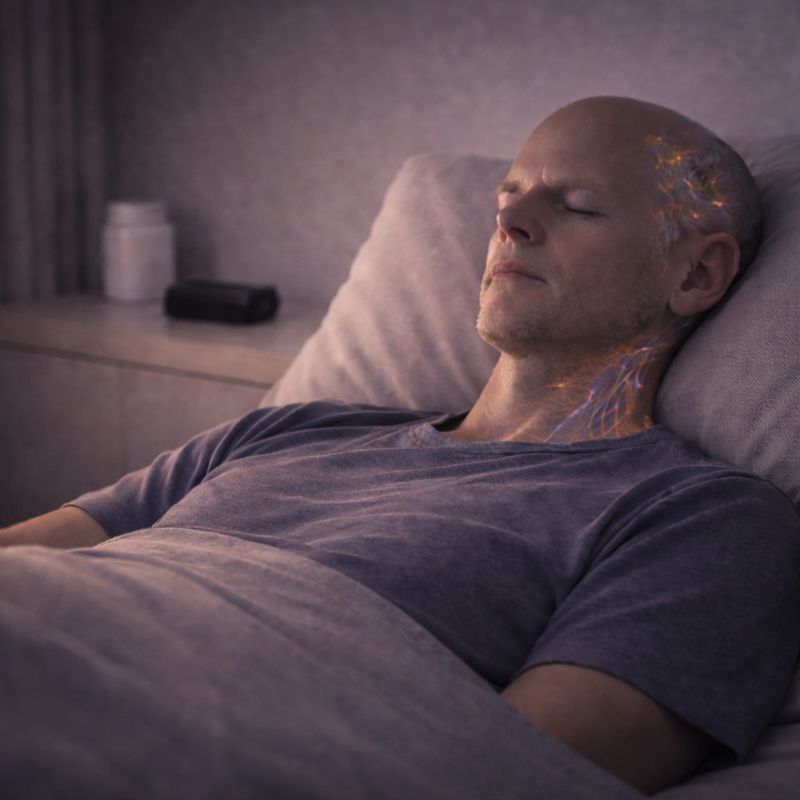
Many people believe their wearable device is accurately measuring deep sleep minute by minute. In reality, most wearables systematically underestimate deep sleep, especially in healthy sleepers. This leads to unnecessary concern, confusion, and poor interpretation of sleep quality.
This article explains why wearables tend to underestimate deep sleep, what they actually measure, and how to interpret their data correctly without undermining real recovery.
What Wearables Can and Cannot Measure
Deep sleep is defined by slow-wave brain activity. The only way to directly detect deep sleep is by measuring brainwaves using electroencephalography.
Wearables do not measure brain activity. Instead, they rely on indirect signals such as movement, heart rate, heart rate variability, breathing patterns, and skin temperature.
Because deep sleep is a neurological state, wearables must infer it rather than measure it.
Why Deep Sleep Is Harder to Detect Than Other Stages
Deep sleep occurs when the body is extremely still and physiologically quiet.
Paradoxically, this makes it harder for wearables to detect. When signals become too stable, algorithms struggle to distinguish deep sleep from light non-REM sleep.
As a result, wearables often classify true deep sleep as lighter sleep stages.
Conservative Algorithms and False Negatives
Most wearable companies design their algorithms to avoid false positives.
This means they prefer to miss deep sleep rather than falsely label it. The result is a systematic bias toward underestimating deep sleep duration.
From a medical safety perspective, this is intentional — but it reduces apparent deep sleep time.
Motion-Based Limitations
Wearables rely heavily on movement data.
If you:
- Shift position during deep sleep
- Have restless muscle activity
- Change posture frequently
the algorithm may downgrade deep sleep to light sleep, even though brainwave-defined deep sleep is still occurring.
Deep sleep does not always mean complete immobility.
Heart Rate Variability Is an Indirect Signal
HRV increases during parasympathetic dominance, which often coincides with deep sleep.
However, HRV alone cannot reliably distinguish between:
- Deep sleep
- Stable light sleep
If HRV patterns are subtle or atypical, wearables may underestimate deep sleep even when recovery is occurring.
Deep Sleep Occurs in Short Bursts
Deep sleep is not a continuous block. It occurs in short, repeating episodes, especially early in the night.
Wearable algorithms may:
- Miss brief deep sleep periods
- Smooth data into longer stages
- Average signals across time windows
This leads to undercounting deep sleep minutes.
Individual Physiology Confuses Algorithms
Sleep algorithms are trained on population averages.
If you have:
- Lower resting heart rate
- Higher baseline HRV
- High fitness level
- Strong parasympathetic tone
your physiological signals may fall outside expected ranges, causing the device to misclassify deep sleep.
Ironically, healthier individuals are more likely to see underestimated deep sleep.
Aging and Sleep Stage Detection
As people age, deep sleep becomes lighter and more fragmented.
Wearables often interpret this fragmentation as reduced deep sleep, even when slow-wave activity is still present.
This exaggerates age-related declines in deep sleep beyond what is physiologically accurate.
Why REM Sleep Is Easier to Detect
REM sleep includes distinct physiological markers such as rapid eye movement, breathing variability, and autonomic shifts.
These markers are easier for wearables to detect than the quiet stability of deep sleep.
As a result, REM sleep is often estimated more accurately than deep sleep.
Why Night-to-Night Deep Sleep Looks Too Low
Many users see deep sleep values that appear far below expected ranges.
This does not necessarily mean deep sleep is absent. It often reflects:
- Algorithm conservatism
- Misclassification
- Physiological variability
Low reported deep sleep is common even in well-rested individuals.
Why Underestimation Is More Common Than Overestimation
Wearables rarely overestimate deep sleep because false positives would undermine credibility.
Underestimation is safer from a product perspective, but misleading for users focused on recovery.
This creates a consistent bias toward lower reported deep sleep.
How This Leads to Sleep Data Anxiety
Seeing low deep sleep numbers can:
- Increase worry
- Elevate nighttime stress
- Reduce actual sleep quality
This feedback loop worsens the very metric users are trying to improve.
Deep sleep is reduced by anxiety about deep sleep.
Why Trends Still Matter Despite Underestimation
Although wearables underestimate deep sleep, they are still useful for relative changes.
If deep sleep trends increase after improving sleep timing or reducing alcohol, the improvement is real even if absolute numbers are low.
Trends are more meaningful than minutes.
How to Interpret Deep Sleep Data Correctly
The most accurate way to use wearable data is to:
- Ignore single-night values
- Track multi-week trends
- Compare behavior changes to outcomes
- Cross-check with how you feel
Deep sleep data should support awareness, not control.
Functional Recovery Matters More Than Metrics
If you experience:
- Good physical recovery
- Stable energy levels
- Low baseline soreness
- Strong workout adaptation
deep sleep is likely sufficient regardless of reported minutes.
Wearables do not measure recovery — your body does.
When Wearable Data Is Still Valuable
Wearables are useful for identifying:
- Effects of alcohol
- Effects of late meals
- Effects of stress
- Effects of poor sleep timing
They are less useful for quantifying exact deep sleep duration.
Why Chasing Deep Sleep Numbers Backfires
Trying to force improvements in wearable metrics often:
- Increases nervous system activation
- Creates sleep performance pressure
- Reduces real deep sleep
Sleep improves when behaviors improve, not when numbers are chased.
Final Thoughts: Why Wearables Underestimate Deep Sleep
Wearables underestimate deep sleep because they do not measure brain activity and rely on conservative algorithms designed to avoid false positives. This leads to systematic undercounting, especially in healthy or well-trained individuals.
Deep sleep should be evaluated through trends, context, and functional recovery — not absolute numbers. When wearable data is used as guidance rather than judgment, it becomes a helpful tool instead of a source of stress.
Continue Exploring Deep Sleep & Recovery
This article is part of the Deep Sleep & Recovery section within the Sleep Optimization framework.
Return to the main guide:
/sleep-optimization/deep-sleep-recovery/
TOPIC RELATED:
• How to Measure Deep Sleep Accurately
• Deep Sleep Scores Explained
• HRV and Deep Sleep Connection
• Can You Trust Sleep Tracker Data?