
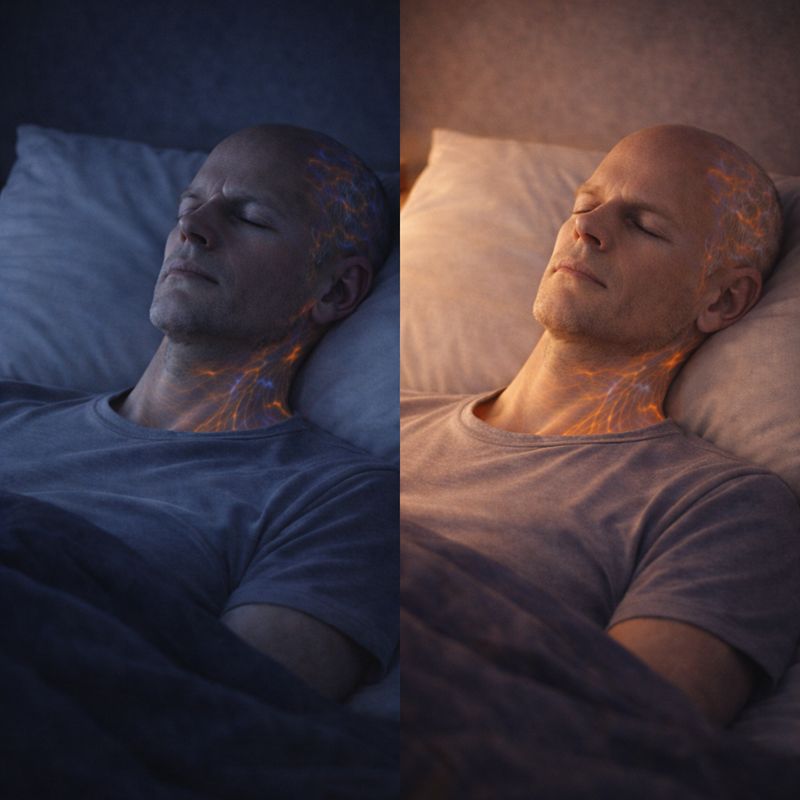
Falling asleep and sleeping deeply requires a fundamental physiological shift: the nervous system must move from sympathetic activation into parasympathetic dominance. When this shift does not occur, sleep becomes light, fragmented, and non-restorative — even if you feel exhausted.
This article explains how to shift from sympathetic to parasympathetic activity at night, why this transition is essential for deep sleep, and what prevents it from happening in modern life.
Sympathetic vs Parasympathetic Nervous System
The autonomic nervous system has two primary branches:
The sympathetic nervous system supports alertness, action, and stress responses.
The parasympathetic nervous system supports relaxation, recovery, digestion, and repair.
High-quality sleep requires parasympathetic dominance. The body cannot enter deep sleep while remaining in a defensive or alert state.
Why Many People Stay Sympathetic at Night
Modern lifestyles frequently maintain sympathetic activation well into the evening.
Common contributors include:
- Psychological stress and rumination
- Late work or cognitive stimulation
- Screen exposure and artificial light
- Late exercise or intense activity
- Irregular sleep schedules
- Overuse of stimulants
Even subtle stressors can prevent the nervous system from downshifting.
The Role of Parasympathetic Activation in Sleep
Parasympathetic dominance allows:
- Heart rate to slow
- Breathing to deepen
- Cortisol to fall
- Muscle tension to release
- Sleep pressure to convert into deep sleep
Without this shift, sleep remains shallow regardless of duration.
Why You Can Feel Exhausted but Still Not Sleep
One of the clearest signs of sympathetic dominance is feeling extremely tired yet unable to relax or sleep deeply.
This occurs when:
- Sleep pressure is high
- Nervous system arousal is also high
Deep sleep requires both fatigue and safety. The parasympathetic system signals safety.
Circadian Rhythm and Nervous System Shifting
Circadian rhythm supports parasympathetic activation at night by reducing alerting signals.
Circadian disruption from:
- Late bedtimes
- Irregular schedules
- Evening light exposure
delays parasympathetic engagement and prolongs sympathetic dominance.
Aligning sleep timing makes the nervous system shift easier.
How Breathing Influences Parasympathetic Activation
Breathing patterns directly influence autonomic balance.
Slow, controlled breathing:
- Reduces sympathetic activity
- Stimulates vagal tone
- Lowers heart rate
- Promotes parasympathetic dominance
Fast, shallow breathing maintains alertness.
Breathing is one of the fastest ways to signal safety to the nervous system.
Heart Rate and Parasympathetic Dominance
Parasympathetic activation is reflected in:
- Lower nighttime heart rate
- Higher heart rate variability
- Slower respiratory rate
When heart rate remains elevated at night, sympathetic dominance is usually present.
Why Forcing Relaxation Doesn’t Work
Trying to “force” relaxation often backfires.
Effort, frustration, and performance pressure are sympathetic behaviors. The parasympathetic system activates when effort decreases, not increases.
The goal is to remove activation, not add control.
Daytime Stress Determines Nighttime Nervous System State
Nighttime nervous system activity is heavily influenced by total daily stress load.
If stress accumulates throughout the day without resolution:
- Sympathetic tone remains elevated
- Parasympathetic activation is delayed
- Deep sleep is reduced
Shifting at night starts with how stress is handled during the day.
Transition Periods Matter More Than Bedtime
The nervous system does not shift instantly at bedtime.
The 1–2 hours before sleep determine whether parasympathetic dominance will occur.
Abrupt transitions from stimulation to bed often fail to downregulate the nervous system.
Gradual transitions are more effective.
Parasympathetic Dominance and Deep Sleep
Deep sleep only occurs under strong parasympathetic dominance.
When parasympathetic tone increases:
- Deep sleep periods lengthen
- Sleep cycles stabilize
- Nighttime awakenings decrease
- Recovery improves
This is why calming the nervous system improves sleep depth more than increasing time in bed.
Signs You’ve Shifted Into Parasympathetic Mode
Indicators include:
- Slower breathing
- Lower heart rate
- Heavy eyelids
- Reduced mental activity
- Physical relaxation
These signs usually precede natural sleep onset.
Why This Shift Gets Easier With Consistency
The nervous system learns patterns.
Consistent timing, light exposure, and routines train the nervous system to downshift automatically at night.
Inconsistency keeps the system alert and uncertain.
Predictability signals safety.
Long-Term Benefits of Parasympathetic Dominance at Night
Regular parasympathetic activation supports:
- Deeper sleep
- Faster recovery
- Lower baseline stress
- Improved emotional regulation
- Better resilience
Sleep quality improves as nervous system balance improves.
Final Thoughts: How to Shift From Sympathetic to Parasympathetic at Night
Shifting into parasympathetic dominance is not about doing more — it’s about reducing activation. When stress signals fall, circadian rhythm aligns, and the nervous system feels safe, deep sleep emerges naturally.
If sleep feels shallow or unrefreshing despite adequate hours, the issue is often nervous system state, not sleep opportunity.
Restore parasympathetic dominance, and sleep will follow.
Continue Exploring Deep Sleep & Recovery
This article is part of the Deep Sleep & Recovery section within the Sleep Optimization framework.
Return to the main guide:
/sleep-optimization/deep-sleep-recovery/